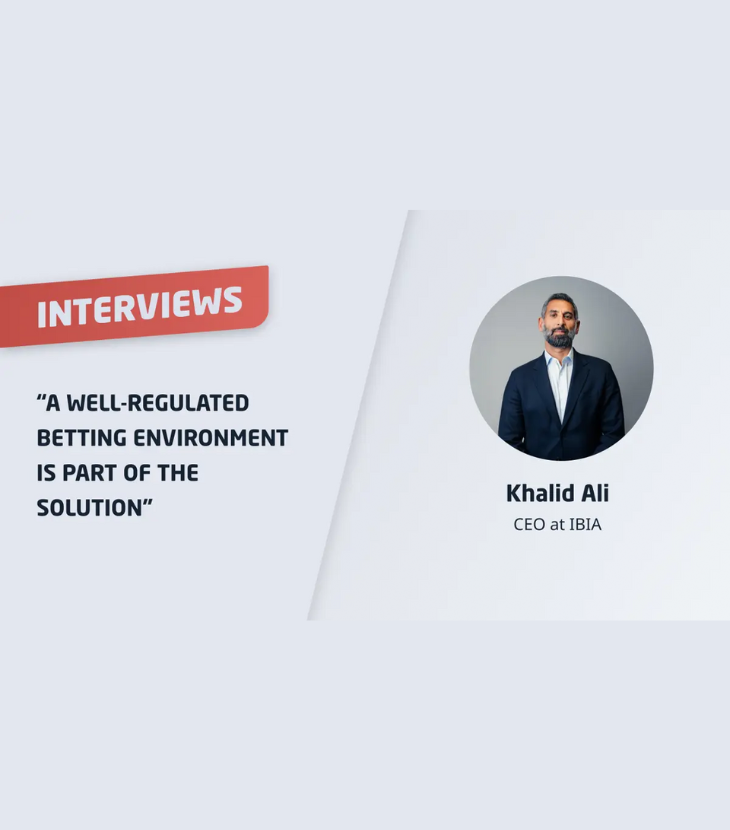
In his exclusive interview with Casino Guru News, Khalid Ali highlights IBIA’s expanding global monitoring network, improved detection of suspicious betting, and strong cooperation with sports and regulators. He stresses that regulated markets enhance transparency, not corruption, and that most sporting events are clean. IBIA’s Mission 2030 aims to strengthen prevention, data-driven enforcement, and global integrity standards.
Q: We have seen IBIA continuously add new members to its ranks. Has this helped strengthen global integrity in sports, and how do new members strengthen IBIA’s monitoring capabilities?
Absolutely. Every new IBIA member brings additional account-level betting data, which expands the reach and sensitivity of our Global Monitoring and Alert Platform (Global Map). Today our members represent over 90 companies and 200 brands, covering more than US$300bn in annual betting turnover and around half of the global regulated online market. That scale allows us to spot suspicious patterns early and across borders. Ouralerts supported sports and regulators in deeming 33 matches corrupted and sanctioning 17 clubs, players and officials in 2024. 2025 data in relation to sanctions has not yet been published but over 20 clubs, players and officials have been sanctioned in 2025 already as a result of IBIA alerts raised
Q: There have been a series of high-profile sports betting scandals in the United States – first the NBA, and now, as it appears, the MLB. Does this mean that the integrity of sports is all the worse for the legalization of gambling?
No. These cases are serious, but they demonstrate that the regulated system is doing exactly what it is designed to do: detect, report and support enforcement. In the Jontay Porter case, suspicious betting was identified by licensed operators and escalated within 24 hours, ultimately leading to NBA sanctions and criminal proceedings. Corruption in sport long predates the legalisation of betting; as INTERPOL and Europol repeatedly highlight, organised crime typically exploits unregulated betting markets. In contrast, regulated markets provide transparency, audit trails and cooperation pathways with sports and law enforcement. A well-regulated betting environment, with monitoring, data sharing and clear sanctions, is part of the solution, not the cause, of these issues.
Q: Do you think sports bettors are disappointed and withdraw from the activity if they suspect cheating has been done? A recent UFC fight involving Isaac Dulgarian was flagged as highly suspicious, and even some prominent sportsbooks returned player wagers even though there is no official confirmation that the fighter intentionally "threw the fight." Are sportsbooks scared of driving potential bettors away?
Fairness and trust is fundamental to both sport and betting, and if customers believe an event may have been compromised, they will take steps to report it and safeguard themselves against similar risks in the future. In a regulated market, operators have the tools to respond quickly: they can raise an alert through IBIA’s Global MAP and stand ready to share account-level data with sports, regulators or law enforcement through authorised channels. This is part of IBIA members’ responsible risk management protocols. Rapid action, transparency and structured cooperation are essential to maintaining bettor confidence and ensuring suspicious activity is detected and dealt with effectively.
Q: Given the scope of what IBIA does, do you think these criminal enterprises that have operated in the shadows of entire major leagues are an exception or that more such illicit activities are going to be coming to light now that the "genie is out of the box"?
Organised crime has targeted sport for decades, often via unregulated betting markets, so this is not a new phenomenon. What is changing is our ability to detect and expose it. Sophisticated schemes can be uncovered when you have data, regulation and investigators from sports or law enforcement working together. In that sense, many of these enterprises are exceptions relative to the huge volume of legitimate sport and betting activity. In football, for example, IBIA data shows that 99.96% of around 950,000 matches offered by our members between 2017 and 2023 raised no betting integrity concerns. IBIA’s account-level monitoring and international alert sharing are designed precisely to bring those "shadow" activities into the open and support sanctions against those involved.
Q: How do you see IBIA’s role in this fraught context for sports betting, and what can you and your members effectively change now to improve sports integrity and look for these aberrative behaviors?
IBIA sits at the intersection of regulated operators, sports, regulators and law enforcement, and our role is to turn betting data into actionable intelligence. Our members’ internal control systems monitor customer account activity 24/7; when unusual patterns are detected, they generate alerts on our platform, which we then analyse and share with the relevant sports and regulators. Between 2020 and 2024 we reported nearly 1,200 alerts worldwide, and last year alone our data contributed to 33 matches being deemed corrupted and 17 sanctions. Beyond monitoring, we help shape better regulation, promote betting integrity requirements for operators and run athlete education programmes built around rules, responsibility and reporting. Those are very concrete levers we can pull now to prevent, detect and deter aberrant behaviour in sport.
Q: In aggregate, do you think sports integrity is better off today than it was 10 years ago, or has sports betting made the temptation stronger for many athletes and people with the right connections?
The temptation has always been there, whether for sporting reasons or financial gain, but we are undoubtedly better equipped today to detect and deal with it. The global regulated betting market has grown significantly. At the same time, better monitoring, clearer rules, tougher sanctions and more comprehensive education programmes mean that suspicious activity is more likely to be detected and punished. Our concern remains concentrated on unregulated markets, and on sports or leagues with weak governance or financially vulnerable athletes. So I would say integrity risks have evolved, but our collective capacity to manage them is stronger than a decade ago.
Q: What is next for IBIA in the coming months?
IBIA is entering an important new phase. As part of our 20th-anniversary strategy, we are rolling out Mission 2030 – our roadmap to become the global standard for sports betting integrity. In the coming months, we will continue upgrading our Global MAP to increase the speed, scale and precision of identifying suspicious betting. We are also expanding our prevention work through evidence-based policy engagement and enhanced player-education programmes. Strengthening collaboration with sports, regulators, law enforcement and payment providers will be a central focus. With our refreshed brand and new website, we are emphasising IBIA’s position as a modern, transparent and globally relevant integrity leader, ready to safeguard sports, responsible regulated operators and consumers in a rapidly changing environment.
For the full article, visit Casino Guru News
Image credit: Casino Guru News